
Private credit has exploded over the past decade, providing borrowers with an increasingly important source of capital and investors with access to attractive yields. But as the market has expanded, so too has the potential for significant disputes when borrowers encounter financial distress, collateral proves insufficient or unreliable, or lenders discover that the information on which they relied does not reflect the underlying reality.
PwC estimates that private credit assets under management have reached approximately $2 trillion and could grow to $3.4 trillion by 2030.[1] At the same time, defaults have increased: Fitch reported a record 9.2% default rate on US private credit loans in 2025.[2]
Recent high-profile collapses on both sides of the Atlantic illustrate examples of the disputes that can follow. Market Financial Solutions (“MFS”) in the UK had borrowed more than £2 billion from various lenders,[3] while First Brands, Tricolor Holdings and 777 Partners have generated significant litigation and regulatory scrutiny in the US. First Brands alone reported approximately $9.3 billion of obligations when it entered Chapter 11 in September 2025.[4]
One credit, many claims
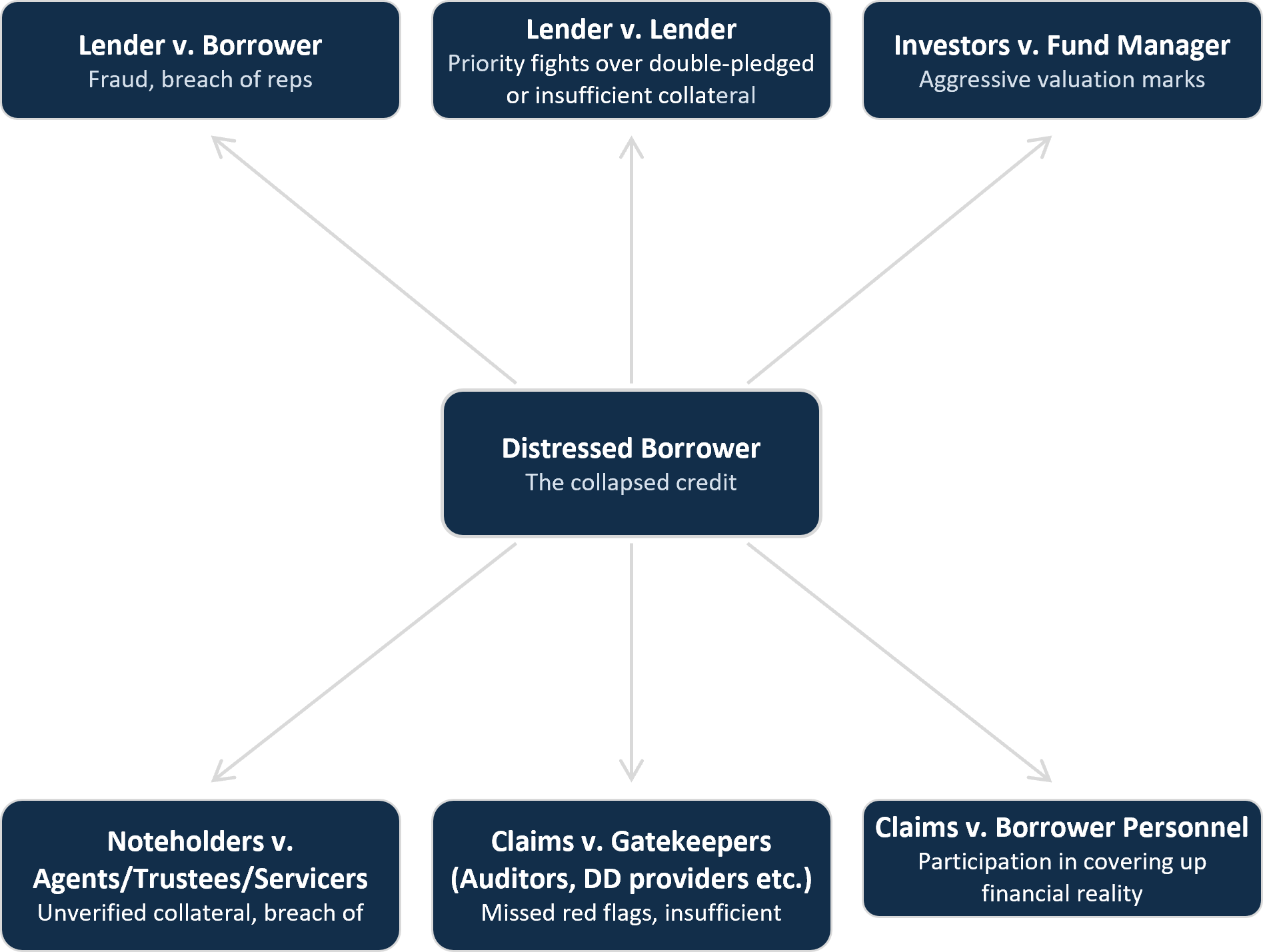
When a private credit borrower collapses, the litigation rarely resolves into a single lender-versus-borrower claim. The same failed credit can give rise to claims involving multiple parties, as shown in Figure 1 below. The legal theories differ, but many of these disputes require the same underlying evidence to be reconstructed. That is where forensic accounting and data analysis can help establish the factual record to support legal counsel.
Following the evidence
Did the collateral exist and who had rights to it?
Several recent private credit failures have involved allegations that collateral was either pledged more than once or did not exist in the form represented to lenders.
Federal prosecutors allege that former executives of Tricolor pledged approximately $2.2 billion of collateral to lenders and investors against a fraction of that amount in genuine assets, using double-pledged auto loans and fabricated vehicle records.[5] Litigation arising from the collapse includes criminal proceedings, trustee claims against former principals,[6] and suits filed by Tricolor’s ABS noteholders against the trustee and backup servicer of the trusts that issued the notes.[7]
Similar issues have arisen in other cases. Allegations involving First Brands include invoice factoring in which receivables were pledged multiple times.[8] Prosecutors have alleged that 777 Partners used doctored financial records and collateral that was either duplicatively pledged or did not exist as represented.[9] MFS has also been associated with allegations of double-pledged property collateral.[10]
In these circumstances, the relevant evidence generally cannot be understood simply by reviewing loan documents in isolation. The analysis may require asset-level or invoice-level reconciliation across multiple facilities to determine:
- what collateral was reported;
- whether the underlying asset or receivable existed;
- which lender was told it had rights to that collateral;
- when those rights were purportedly created; and
- whether the same asset appeared in more than one borrowing base or collateral pool.
The decisive evidence may sit across loan tapes, invoice data, borrowing base certificates, bank records, servicing systems and documents produced by different parties, as well as in regular communications between individuals. Establishing the facts therefore frequently requires combining and reconciling disparate information in multiple formats that were not designed to be analyzed together.
Did the borrower’s reporting reflect the underlying data?
Where lending is supported by a borrowing base,[11] another important forensic exercise is reconstructing how the borrowing base evolved over time.
This may involve validating the data and calculations underlying borrowing-base certificates against source records, testing eligibility criteria, and identifying when reported collateral or availability began to diverge from the underlying assets presented.
Potential warning signs can include duplicate or sequential invoices or asset identifiers, unusual concentrations of related-party obligors, borrowing bases persistently at or close to maximum availability, or resistance to independent collateral verification.
The objective is not simply to identify discrepancies after the event. A reconstruction exercise can establish when the discrepancies emerged, how material they became, and what information was available to lenders or other parties at key decision points.
Where did the money go?
Where misuse or diversion of loan proceeds is alleged, funds-flow analysis may provide another critical part of the evidentiary record.
Tracing loan proceeds through borrower and related-party accounts can help establish whether funds were used for their stated purpose, transferred to affiliated entities, recycled through accounts, or applied in ways inconsistent with lender representations.
This work can become particularly important where the dispute concerns not only whether financial information was inaccurate, but whether borrower personnel deliberately concealed the company’s true financial position or diverted financing away from its intended purpose, often for personal gain. Such analysis can help establish not only how any fraud was perpetrated and by whom, while also identifying potential avenues for recovery, restitution, or disgorgement.
What did the relevant parties know, and when?
When a credit fails, due diligence and monitoring processes are often reassessed with the benefit of hindsight. The more useful forensic question, however, is generally not whether a lender “should have known” that a borrower would ultimately fail, but instead, what information was available at each point in time, what procedures were actually performed, the exceptions or warning signs that arose, and how they were handled. Addressing these questions requires obtaining and evaluating contemporaneous records.
Credit memoranda, financial analyses, cash-flow models, field examinations, exception approvals, correspondence and internal review records can be reconstructed to establish who reviewed particular information, what conclusions were reached, and whether subsequent lending decisions were consistent with the information then available.
This distinction can be particularly important where fraud is alleged. Sophisticated fraud may not be apparent even where reasonable due diligence has been undertaken, particularly where records have been deliberately fabricated or altered. A forensic review can help distinguish information that was available at the time from warning signs that become apparent only after a collapse.
The same exercise may extend beyond lenders. Recent regulatory action relating to MFS illustrates how questions can also reach auditors, accountants and other service providers where authorities investigate whether warning signs should have been identified.[12][13]
Questions for the gatekeepers
Where fraud is suspected, scrutiny may extend beyond the borrower and its personnel to service providers, including auditors, accountants, due diligence providers, and other advisers. Questions may arise as to what information was available to those parties, whether relevant warning signs were identified and, if so, how they were addressed.
The MFS matter provides a recent example. Following enforcement action by the UK Financial Conduct Authority in March 2026,[14] the UK Financial Reporting Council announced investigations in June 2026 into the conduct of several accounting firms and individuals in relation to services provided to MFS and related companies.[15]
When the records themselves cannot be relied upon
Some of the most difficult cases arise where the documents on which lenders relied were themselves fabricated or altered.
US prosecutors allege that 777 Partners used fabricated records and doctored financial statements in a scheme that defrauded lenders and investors of more than $500 million.[16] Allegations involving other recent failures have similarly included false underlying records and fictitious collateral.
In these circumstances, traditional accounting analysis may need to be combined with digital forensic techniques. Metadata, file histories, system records, and document versions may help determine when documents were created or modified, whether purportedly independent records have a common origin, and whether the underlying data supports the documents presented to lenders.
In these matters, the forensic exercise is often one of building the evidentiary record rather than simply locating it. The core forensic workstreams can include:
- Collateral tracing – reconciling assets and invoices across competing facilities to establish what was pledged, to whom, and how many times.
- Borrowing base reconstruction – checking the data in borrowing base certificates and eligibility calculations against underlying source records.
- Funds flow analysis – tracing loan proceeds through bank accounts and related entities.
- Document authenticity – examining financial records, invoices and associated metadata for indications of fabrication or alteration, and reconciling accounting records to separately maintained treasury records where inconsistencies may exist.
- Solvency analysis – establishing when a borrower became insolvent for purposes of fraudulent transfer, clawback, and related claims.
The valuation battleground
Collateral and fraud are not the only potential sources of dispute. Valuation is also receiving increasing attention, particularly when a private credit asset is carried close to par shortly before a significant write-down or default. But the incentives to value assets aggressively are real – higher valuation marks flatter fund performance and fee income; however, inaccurate valuations open the door to potential disputes.
BlackRock TCP Capital, for example, reportedly valued its roughly $150 million exposure to Renovo Home Partners at approximately 100 cents on the dollar in late September 2025. Within weeks, Renovo entered Chapter 7 liquidation, and the debt was subsequently written down to zero.[17] BlackRock TCP Capital also recorded a significant write-down of its exposure to Infinite Commerce Holdings after carrying the loan at par as recently as the third quarter of 2025.[18]
A sharp change in valuation does not by itself establish that an earlier mark was inappropriate. The relevant question is what information supported the valuation at the time it was made. That analysis can become particularly significant where different funds hold the same or comparable debt at materially different valuation marks. Divergent valuations can provide a useful benchmark for investors, defendants and regulators and may lead to scrutiny of the methodology, assumptions and contemporaneous information underlying each valuation. Recent analysis puts the gap between the most optimistic and most conservative valuation marks on the same loans held by different managers at more than five percentage points, [19] and, in the case of First Brands, a number of funds carried the debt above 90 cents on the dollar only weeks before it was quoted below 20 cents on the dollar.[20]
Those issues are already attracting regulatory attention. Former US Attorney for the Southern District of New York, Jay Clayton, has publicly discussed scrutiny of potential valuation discrepancies involving First Brands, Tricolor Holdings, and 777 Partners,[21] while the Department of Justice has reportedly been reviewing valuation practices in certain BlackRock private credit funds.[22]
Forensic analysis in these matters may therefore involve reconstructing the information available at each valuation date, comparing valuation marks across holders, examining changes in assumptions, and assessing whether subsequent events genuinely represented new information or reflected conditions that were already apparent.
Expanding on the valuation concern further, consider from an accounting perspective: even if one loan in isolation is not materially overstated, would application of the same degree of overstatement across the entire loan portfolio result in material overstatement at the fund or balance sheet level?
Practical considerations for counsel
The recent private credit failures provide several practical lessons for counsel advising lenders, fund managers, investors and other participants.
- A single failed credit can generate multiple disputes. Early analysis of collateral, cash flows, and contemporaneous records can help determine which potential claims have evidentiary support and how they may best be pursued or defended.
- The key evidence is often accounting and transactional evidence. Due diligence files, borrowing base certificates, loan tapes, bank records, underlying accounting records and related source documents, valuation reference materials and mark histories will be the core documents in these disputes.
- Timing matters. Reconstructing when a discrepancy arose, and what each party knew at that point, can materially affect the analysis of causation, reliance, diligence, and damages.
- Valuation marks are discoverable and comparable. When the same loan is held across multiple funds, valuation differences may provide an important reference point. However, the underlying information and methodology supporting each mark must also be understood.
- Evidence should be preserved early. As soon as a credit becomes contentious, securing source data, transaction records and contemporaneous valuation and diligence materials can be critical, particularly where data resides across multiple systems or parties.
FRA’s work on private credit disputes and investigations includes its retention in the First Brands Chapter 11 proceedings. Our teams are currently addressing several of the issues described in this article through funds flow analysis, reconciliation of large volumes of financing and accounting data across disparate systems, and targeted reviews of treasury records for indications of fabrication or alteration.
For more information on how FRA can assist with private credit disputes and investigations, contact FRA experts Andrew Hayes, Charlie Patrick, or Isabelle Vinter to discuss how we can help with matters in this space.