Higher tariffs, proactive enforcement, and whistleblower incentives are turning customs compliance into a material civil and criminal enforcement risk.
Customs compliance can no longer be a back-office import function. Elevated tariffs, increased interagency coordination, and the expanding use of the False Claims Act (“FCA”) have made customs fraud a priority enforcement issue for companies that import goods into the United States. The result is a risk environment in which inaccurate classification, valuation, country-of-origin, or duty treatment can create significant financial exposure and, in some cases, criminal charges.
The enforcement landscape has also changed. The U.S. Department of Justice (“DOJ”) and the Department of Homeland Security (“DHS”) launched a cross-agency Trade Fraud Task Force in August 2025 to pursue tariff evasion, duty avoidance, and prohibited imports through civil, administrative, and criminal tools. Less than a year later, DOJ announced that the Task Force had surpassed $1 billion in civil and criminal recoveries.
For importers and distributors, the message is straightforward: customs risk is now enforcement risk. Companies that have historically treated tariff compliance as a technical trade issue should expect greater scrutiny from regulators, whistleblowers, competitors, and other market participants who may have visibility into pricing, sourcing, and supply-chain practices.
Tariffs remain central despite legal challenges
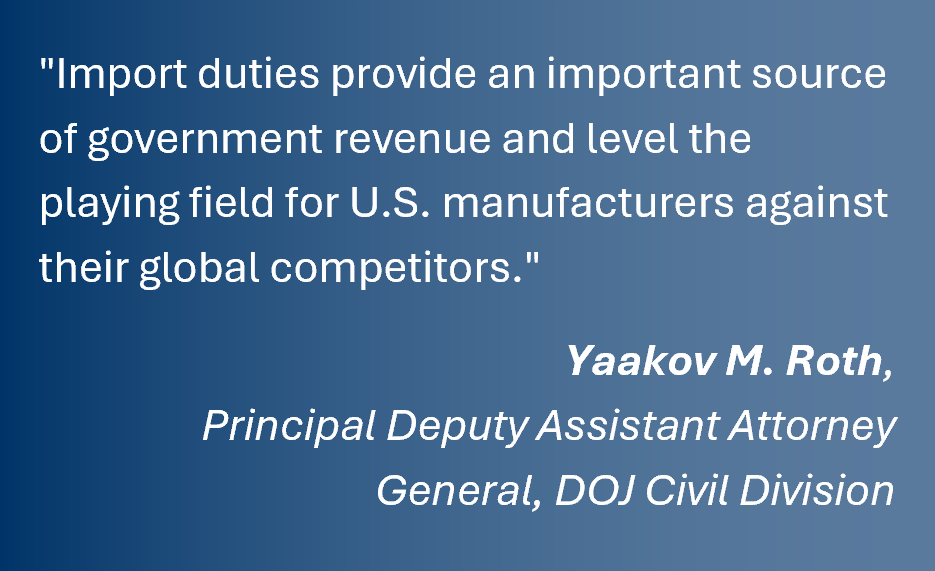
Despite the February 2026 Supreme Court ruling stating that the President does not have the power to impose tariffs under the International Emergency Economic Powers Act (“IEEPA”), the government has continued to pursue tariff measures through alternative statutory authorities, including Section 122 of the Trade Act of 1974, Section 301 of the Trade Act of 1974, and Section 232 of the Trade Expansion Act of 1962.
The legal pathway may shift, but the practical consequence for importers is consistent: tariffs remain a major cost of doing business.
Why higher tariffs increase fraud risk
Changes in tariff rates from historical 2–3% to present averages of 7–11% mean that the financial impact on importers is considerable. A Penn Wharton Budget Model projects that existing long-term tariffs will amount to US $2.1 trillion over the next decade.[1] As effective tariff rates rise, so does the financial incentive to understate duties through improper classification, valuation, origin declarations, or treatment of goods subject to anti-dumping and countervailing duties.
The risk is not limited to deliberate fraud. Customs declarations often depend on complex supply-chain, tax, finance, procurement, and logistics data. If those functions are not aligned, a company may lack the documentation needed to defend its position when the government challenges the declared treatment.
How customs fraud is perpetuated
Many enforcement actions stem from inaccurate customs declarations or failures in supply chain due diligence. Common trade compliance and supply chain risks include:
- Misclassification: Goods imported are classified under the Harmonized Tariff Schedule codes that dictate the exact customs duties, tariffs, and taxes owed on imports. Codes can also verify if goods qualify for lower duties under free trade agreements. Misclassification occurs when goods are entered under an incorrect HTS code.
- Undervaluation: Tariffs are computed based on the effective rate (typically percentage based) multiplied by the Customs Valuation. Undervaluation occurs when the declared customs value does not accurately reflect the price paid, minus allowed adjustments for specific costs.
- Country of Origin: Different tariffs may apply for similar goods imported from different countries, resulting in the potential misreporting of the country of origin to a market with lower tariffs. Goods may also be routed through an intermediary country to obscure their true origin. This practice can also avoid anti-dumping penalties, trade embargoes, forced-labor restrictions, or other country-specific restrictions imposed on the country of origin.
- Other: Customs fraud can also occur through: i) circumvention or avoidance of anti-dumping / countervailing duties (“AD/CVD”) via paperwork manipulation or the superficial manufacturing of product in another market; and ii) inappropriate claiming of Free Trade Agreement eligibility (reduced or zero duty rates if meeting strict rules defined in such agreements).
Enforcement mechanisms are more coordinated
The government has made it clear: customs fraud will be enforced aggressively. While customs fraud enforcement is not new, previous administrations generally took a more reactive approach. That has now shifted to a more coordinated, proactive enforcement strategy.
The August 2025 launch of the Trade Fraud Task Force combines DOJ’s civil and criminal resources with DHS, U.S. Customs and Border Protection (“CBP”), and Homeland Security investigations to pursue duty evasion and related misconduct across the supply chain, including importers, customs brokers, distributors, end-users, and other actors who may knowingly benefit from goods imported contrary to law.
Executive Order 14411, issued in June 2026, seeks reforms to increase enforcement and penalty standards, including higher minimum penalties, reduced mitigation, and streamlined seizure and disposal processes. It also prioritizes investigations into misclassification, undervaluation, illegal transshipment, and forced labor.[2]
The False Claims Act is central to this enforcement landscape. In customs cases, the government may pursue a “reverse false claim” theory on the basis that a company knowingly made false claims to reduce or avoid a financial obligation owed to the government. The FCA can carry some significant penalties for violations including triple damage, which is heightened by the ability of not only the government to file, but also for a whistleblower to file a claim for which they can be eligible for 15-30% of amounts recovered if the case is successfully brought.
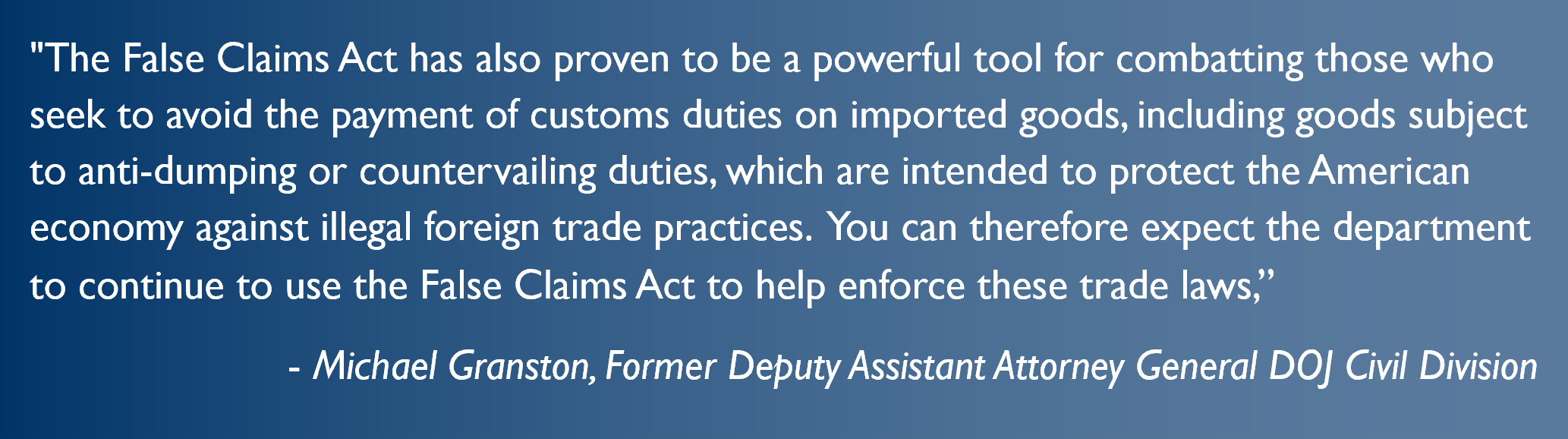
That whistleblower dynamic is particularly significant in the trade context. Employees may have direct knowledge of internal classification, valuation, or origin decisions, while competitors may infer potential evasion from pricing, sourcing, or market behavior. Of the approximately $78+ billion recovered by the US Government under total FCA claims since 1986, approximately 70% arose from whistleblower (or “qui tam”) actions.
Proactive enforcement is also increasingly data-driven. CBP has publicly stated that it uses the latest data analytics tools to uncover tariff evasion schemes, including undervaluation, misclassification, transshipment, AD/CVD violations, shell companies, and improper claims to multiple tariff exemptions.[3]
For more egregious conduct, civil exposure may be accompanied by criminal scrutiny. The government, through the Trade Fraud Task Force, has been rapidly increasing the level of criminal enforcement for alleged customs fraud. Government representatives have reiterated their position that trade fraud is now treated as a serious economic crime, that penalties should not merely be viewed as a “mere cost of doing business.” The risk of criminal prosecution for individuals is now very real, with severe statutory penalties that may include maximum prison sentences ranging from 2 to 20 years, multi-million-dollar fines, and mandatory forfeiture of assets.
Watch our webinar recording, When Customs Fraud Meets the False Claims Act, for insights on customs enforcement and FCA risk here.
Recent enforcement
Recent cases show the range of conduct now attracting significant enforcement attention. The largest customs fraud settlement in FCA history was announced in May 2026 with a $549.5 million settlement with the US Aluminum Extruders Coalition, who knowingly evaded anti-dumping and countervailing duties on Chinese aluminum extrusions. The settlement illustrates the scale of potential exposure where duty evasion may be deliberate and known.
Country-of-origin and transshipment allegations are also prominent, with a $54.4 million settlement by a metals company in December 2025 over transshipment of metals manufactured in China through third countries to disguise the country-of-origin. The case underscores the need for importers to understand the actual production flow and retain the necessary documentation supporting origin claims.
Undervaluation matters further demonstrate risk, an example of which is a June 2026 bankruptcy-related claim for $285.5 million alleging undervaluation of auto components imported from China.
The criminal prosecutions for customs fraud add another element to enforcement. In July 2026, co-owners of a gold importer were criminally charged with allegations that gold was falsely disclosed as originating from Singapore instead of the UAE, which led to the underreporting of $38 million in tariffs.
The Bottom Line
Customs fraud enforcement has entered a more prominent phase. Elevated tariffs increase the financial stakes, data-driven targeting gives agencies more ways to identify anomalies, and the False Claims Act gives whistleblowers and competitors a powerful channel to bring allegations forward. The era of "informed compliance" has given way to enforced compliance.
In a subsequent article, we will address what companies should do now: reassessing tariff exposure, validating classification and country-of-origin positions, reviewing valuation controls, strengthening supplier diligence, and documenting customs decisions in a way that can withstand regulatory, whistleblower, competitor, or transaction-related scrutiny.